Lesson plan
Learners send rays of light into acrylic blocks and lenses on a protractor disc, watch each ray bend as it enters and leaves, and use what they see to explain a coin that seems to rise in a bucket of water.
🎯General objective
Explain what refraction of light is, design and carry out simple experiments showing light bend as it passes from one transparent material into another, and connect it to things they see every day.
✅Specific objectives
By the end of the lesson, learners should be able to:
- Explain in their own words what refraction of light means.
- Show with a ray of light that it bends as it enters and as it leaves a transparent block.
- Compare what a convex lens and a concave lens do to three parallel rays.
- Explain why a coin in water looks nearer the surface than it is, and why a riverbed looks shallower.
🧰Teaching and learning materials
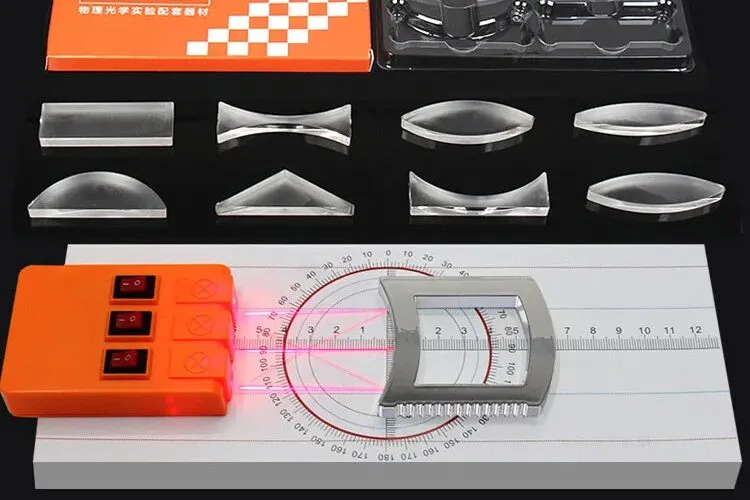
- Three-ray light box with its power supply.
- Optical disc or protractor board marked in degrees.
- Rectangular block, semicircular block, convex lens and concave lens from the kit.
- Plain A4 paper, a sharp pencil and a ruler for each learner.
- A bucket of clean water and a coin, for the whole class.
📐Lesson steps 80 min in total
-
1
A coin that moves
Stand a coin at the bottom of a dry bucket. Learners step back until the rim just hides it, then one learner pours water in slowly while everyone else stays still. The coin comes back into view. Ask what moved. Take answers but do not settle it yet.
-
2
Safety and first look
Hand out the light boxes, discs and rectangular blocks. Rules first: the box stays flat on the table, nobody looks into the beam, nobody points it at a face. Groups switch on one ray only and send it into the block at a slant, watching the point where the ray meets the surface.
-
3
Drawing the bend
Groups stand the block on paper, draw round it, mark where the ray goes in and where it comes out, then lift the block and join the marks with a ruler. The ray bends in at the first face and back out at the second, leaving parallel to how it started but shifted sideways. Name it: refraction, the bending of light.
-
4
Straight in, no bend
Groups aim the ray straight at the surface, square on, and find it passes through without bending at all. They record both cases side by side and discuss what makes the difference.
-
5
What lenses do
Switch on all three rays. Groups send them into the convex lens, then the concave lens, drawing what the three rays do each time. Name each lens by what it does: one brings light together to a point, the other spreads it out. Link to spectacles, a magnifying glass and a phone camera.
-
6
Back to the coin
Return to the bucket. Learners now explain the coin using the word refraction. Add the riverbed: water always looks shallower than it is, which is why a river is dangerous to judge by eye. Each learner writes one sentence defining refraction and one example from home.
📝Assessment
- Written
- Three short questions, what refraction means, why a ray bends entering a block at a slant but not square on, and why a coin in water looks closer to the surface than it is.
- Practical
- Groups set up the bucket-and-coin experiment themselves and explain it to the class.
- Drawing
- Each learner draws a ray entering and leaving a rectangular block and marks where the bending happens. Look for bending at both surfaces most learners draw only the first.