Lesson plan
In pairs, learners connect a dry cell, wires, a switch and a bulb until the bulb lights. They find out why it sometimes does not, and discover that the path has to run all the way round and back.
🎯General objective
Build and control a simple electric circuit, and explain why the bulb lights only when the path is complete.
✅Specific objectives
By the end of the lesson, learners should be able to:
- Name the four parts of a simple circuit: the cell (battery), the wires, the switch and the bulb.
- Connect the parts so that the bulb lights.
- Open and close the switch and say what happens each time.
- Find the break when the bulb does not light.
🧰Teaching and learning materials
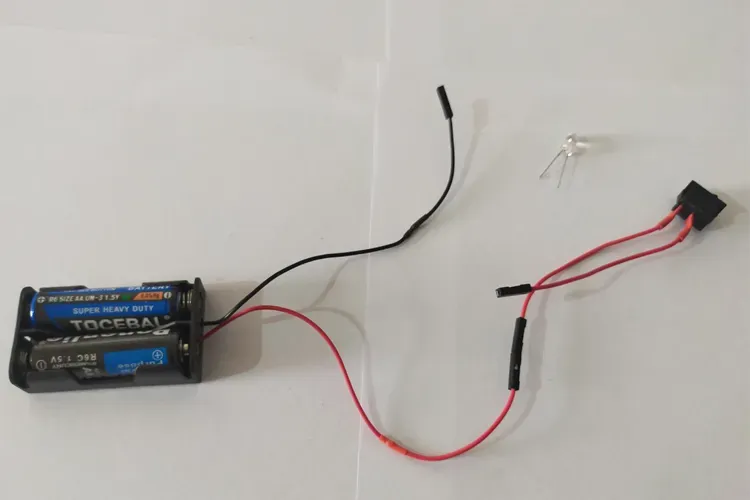
- Dry cells in its holder, per pair
- One switch, one bulb, and wires, per pair
- One circuit already built, for the teacher to show
- Exercise books for the drawing
📐Lesson steps 80 min in total
-
1
A bulb that will not light
Show the class a circuit you built beforehand, with one wire quietly left loose. Press the switch: nothing happens. Ask why. Take their ideas, then push the wire back on and let the bulb light. Give them the two words they will use all lesson: the path is complete, or it is broken.
-
2
Naming the parts
Pairs lay out their four parts and name each one aloud: cell (battery), wires, switch, bulb. Show them the two ends of the cell and the two sides of the bulb holder. Each learner draws the four parts in their book before anything is connected.
-
3
Make it light
Pairs connect the cell to the switch, the switch to the bulb, and the bulb back to the cell, then close the switch. Many will not light first time, and that is the lesson. Do not fix it for them: ask each pair to press every joint in turn until they find the one that is loose. Every pair should have a lit bulb before this stage ends.
-
4
Break it on purpose
With the bulb lit, pairs break the path in three places, lift one wire off the cell, open the switch, loosen the bulb and say each time whether it lights. They conclude that the path must be complete the whole way round, and that a switch is simply a gap we can open and close when we choose.
-
5
Draw it, then pack it away
Each learner draws their own circuit and labels the cell, the wires, the switch and the bulb. Finish with the safety rule, said out loud by the class: a dry cell is safe to hold, a wall socket is never to be touched. Cells come out of the holders before the kits are packed away.
📝Assessment
- Observation, as the scheme asks: Can the pair light the bulb without help? Note which pairs needed it and which found their own loose joint.
- Peer review
- Pairs swap circuits after one partner has quietly broken something. The other pair has two minutes to find it.
- Oral
- Name the four parts, and say why the bulb goes out when the switch is opened.
- Drawing
- A labelled circuit in the exercise book.