Lesson plan
Learners run a magnet car over a tray of objects and watch which ones jump up and stick. Clips and nails come along; plastic beads and gears stay behind. They predict first, then test, then sort and name what they found.
🎯General objective
Identify magnetic objects from non-magnetic ones by testing them, name the materials in each group, and handle magnets safely.
✅Specific objectives
By the end of the lesson, learners should be able to:
- Say in their own words what a magnet is and what it does.
- Sort objects into magnetic and non-magnetic by testing each one with the magnet car.
- Name at least three magnetic and three non-magnetic objects.
- Say what they expect to happen before testing, and whether they were right.
🧰Teaching and learning materials
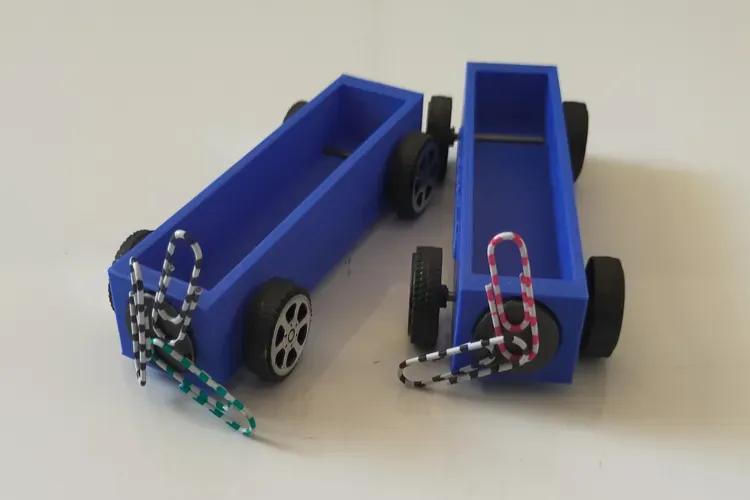
- Two magnet cars per group.
- Metal objects: paper clips, nails, screws, safety pins.
- Plastic objects: beads, gears, buttons, rubber bands.
- A sheet of paper per group, folded into two halves.
📐Lesson steps 80 min in total
-
1
Two cars that will not touch
Stand the two cars nose to nose and push one gently towards the other. It pushes the second away without ever touching it. Turn one car round and they snap together on their own. Ask the class what is doing the pushing and the pulling. Give them the word: magnet.
-
2
Guess before you test
Each group gets a tray of objects and a sheet folded in two. Before anything is tested, they put every object on the side they think it belongs to: will the car pick this up, or not? Groups write their guesses down. No testing yet, and no hints.
-
3
Test with the car
Groups run the magnet car slowly over each object. Clips, nails, screws and pins jump up and ride along; beads, gears, buttons and rubber bands stay where they are. Each object moves to the half it really belongs to, and groups mark which of their guesses were right.
-
4
Not every metal
Hold up the coin, the aluminium and the copper wire, and ask the class to vote: metal, so surely magnetic? Test them in front of everyone. Some metals are not picked up at all. This is the point of the lesson: magnetic does not mean metal, it means iron and steel.
-
5
Writing it down
Each learner rules two columns in their book and writes at least three objects under each heading. Close by asking where they have seen a magnet at home, the fridge door, a cupboard catch, a radio speaker, a phone cover.
📝Assessment
- Practical
- hand each learner three objects they did not test, and ask them to say magnetic or not before checking with the car.
- Written
- two columns, three objects correctly placed in each.
- Oral
- why does the car pick up the clip but not the bead? Look for an answer about what the object is made of, not about its size or weight.