Lesson plan
Learners meet a real robot, program it in PictoBlox to drive forward, reverse and turn, then add its obstacle sensor so it reacts to the world and end by naming a job a robot could do in their own community.
🎯General objective
Explore and apply robotics as an emerging technology by giving a real robot instructions, and reflect on tasks such a robot could do for people in their community.
✅Specific objectives
By the end of the lesson, learners should be able to:
- Name robotics as an emerging technology and describe where robots are already used in Rwanda and elsewhere.
- Connect the robot to PictoBlox and program it to move forward, backward and turn.
- Use the obstacle sensor so the robot stops or turns away when something is in its path.
- Suggest a real problem in their school or community a robot could help with, and explain why.
🧰Teaching and learning materials
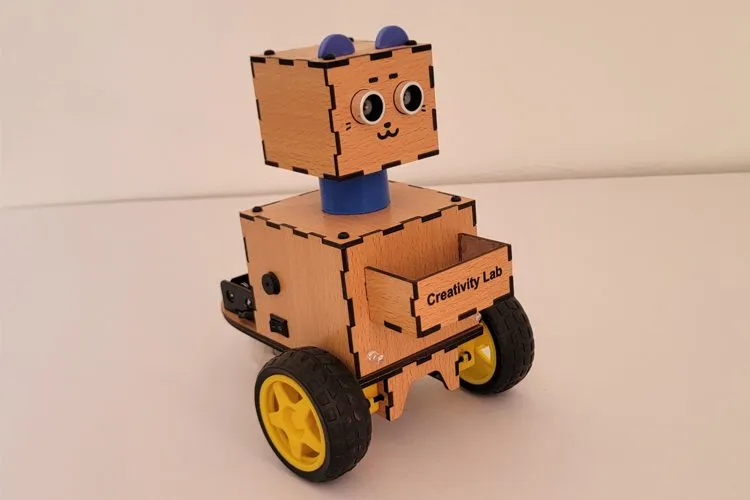
- BWENGE Robot with its user guide.
- Laptop with PictoBlox installed and the USB cable.
- Charged batteries for the robot.
- Obstacle.
📐Lesson steps 80 min in total
-
1
Machines that follow instructions
Name machines the class already knows that follow instructions: a washing machine, a microwave, a phone. Then drive the robot across the front of the room. Ask what makes it a robot rather than a toy car, and draw out the two answers: it takes instructions, and it senses what is around it. Collect examples of robots used in farming, hospitals, factories and mines.
-
2
Meeting the robot
Groups receive a robot and its guide. Before any code, they find and name the parts: two wheels each with its own motor, the obstacle sensor at the front, the board, the battery. Explain from the guide that each motor is driven by two digital pins and cannot be told to go two ways at once.
-
3
First instructions
Groups connect the robot, open PictoBlox, choose the board and the port, and upload firmware as the guide sets out. They test each wheel on its own first, then write their first program: drive forward for two seconds, then stop. Expect the port step to be where most groups need help.
-
4
Making it turn
Groups work out for themselves that turning means driving one wheel while the other stops or reverses. They program forward, turn, forward, and run the robot along a taped track or around a desk. Compare how different groups achieved the turn more than one answer is right, and that is worth saying out loud.
-
5
Giving it a sense
Put a box in the robot's path. Groups add the obstacle sensor: if something is close, stop or turn away. Name what has changed the robot is no longer only repeating instructions, it is reacting to the world. This is the line between a machine and a robot.
-
6
What could it do for us?
Each group names one real task a robot could do in their school, home or community, and says what it would need to sense in order to do it. Collect the answers on the board under health, farming, safety and learning. Shut the robots down and take the batteries out before packing away.
📝Assessment
- Practical
- Each group shows their robot driving forward, turning, and reacting to an obstacle, and explains what each block in their program does.
- Presentation
- One minute per group on a problem in their community a robot could help with, and which emerging technology they would pair it with.
- Written
- Name three emerging technologies and one real use of each; explain in two sentences what makes a robot different from a remote-controlled toy.