Lesson plan
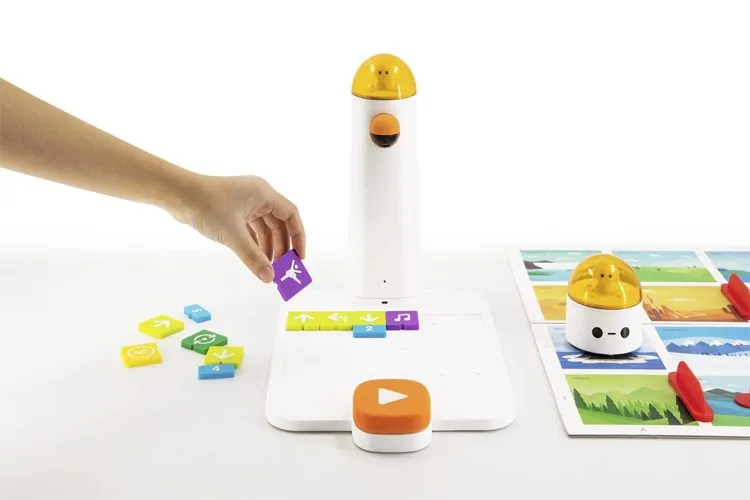
Children lay out icon blocks to build a program, then watch the robot carry it out. Because the program sits on the board and not inside the robot, they can look at it, change it and read each other's before anything moves.
🎯General objective
Build a program from icon blocks that drives a robot to a chosen place, predict what it will do before running it, and find the mistake when it does something else.
✅Specific objectives
By the end of the lesson, learners should be able to:
- Place command blocks in order to make the robot reach a target.
- Say where the robot will stop before pressing run.
- Find and fix the wrong block when it goes somewhere else.
- Read another group's program and say what it will do.
🧰Teaching and learning materials
- One Coding Set Pro per group.
- A mat or grid, with a flag or picture on the target square.
- Small objects to place as obstacles.
- Paper and pencil for drawing the route before building it.
📐Lesson steps 60 min in total
-
1
The program you can see
Build a three-block program in front of the class and leave it on the board without running it. Ask children what the robot is going to do, before it moves. Then run it. The important idea is in that gap: the program exists and can be read while the robot is still sitting still.
-
2
Reach the flag
Put the flag four or five squares away. Groups lay out their blocks, then run. Most will miss the first time. Do not point at the wrong block, ask them to put a finger on each block in turn and say out loud what the robot will do, in order. They find it themselves.
-
3
Nobody presses run until everybody agrees
New rule for this stage: before running, every child in the group must say where they think the robot will stop. If they disagree, they talk first and run second. Set three targets, each a little further than the last.
-
4
Doing the same thing again
Give them a square to drive: forward, turn, forward, turn, forward, turn, forward, turn. Then ask whether there is a shorter way to say it. If your set has the repeat block, this is where it earns its place; if not, the question alone is worth asking.
-
5
Read someone else's
Groups swap boards without swapping robots. Each group looks at the other's program and says what it will do and where the robot will end up. Then they run it and find out.
📝Assessment
- Watching rather than marking
- can a child place blocks in an order that reaches the target?
- Can they say where the robot will stop before it runs, and are they usually right?
- When it goes wrong, do they look at the program, or do they just try again randomly?
- Can they read a program somebody else built?