Lesson plan
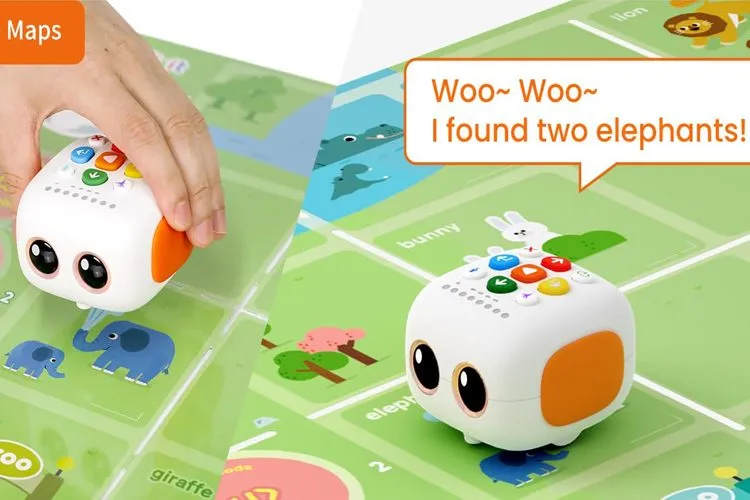
Children press buttons to send a robot across a map, square by square, to reach a picture. When it arrives it plays back their own recorded voice telling that part of the story. No screens, no reading required.
🎯General objective
Give a robot a sequence of instructions to reach a place on a map, and record a spoken story that the robot tells along the way.
✅Specific objectives
By the end of the lesson, learners should be able to:
- Press one button and say what the robot did.
- Put several commands in order to reach a chosen square.
- Find the mistake when the robot stops in the wrong place, and fix it.
- Record their own voice and tell one part of a story.
🧰Teaching and learning materials
- One Tale-Bot Pro per group, charged
- An interactive map, or a grid drawn on card with pictures taped to some squares
- Picture cards of animals, people or places, to choose a story from
- A quiet corner for the recording
📐Lesson steps 60 min in total
-
1
Meet the robot
Children sit round the robot on the map. Press forward once: it moves one square and stops. Press forward, forward, turn: it does all three, in that order, by itself. Give them the two ideas without the words one button is one instruction, and the robot does them in the order you gave.
-
2
Reach the picture
Put a picture three or four squares away. Children decide which buttons to press, press them, and watch. Most groups will miss the first time. Do not correct it: ask one child to stand up and walk the path themselves, saying each step out loud. Then try again.
-
3
Give the robot your voice
Each group chooses a picture on the map and records one sentence about it in their own voice, who is there, and what is happening. The robot plays it back when it arrives. Let them re-record as often as they like; hearing themselves is half the value.
-
4
Three stops, one story
Groups pick three pictures and plan a route that visits all three. Each child records the part for one stop. They now have a story with a beginning, a middle and an end, told by a robot that drives between them.
-
5
Tell it to the room
Each group runs its story for the others. The group says nothing while it plays, the robot and their recorded voices do the telling.
📝Assessment
- Watching rather than marking, at this age: can the child press a sequence and predict where the robot will stop?
- Can they say what went wrong when it stops in the wrong square, in their own words?
- Did they record a sentence and tell their part to the group?
- Over several weeks
- how many steps long a sequence they can plan before trying it.